
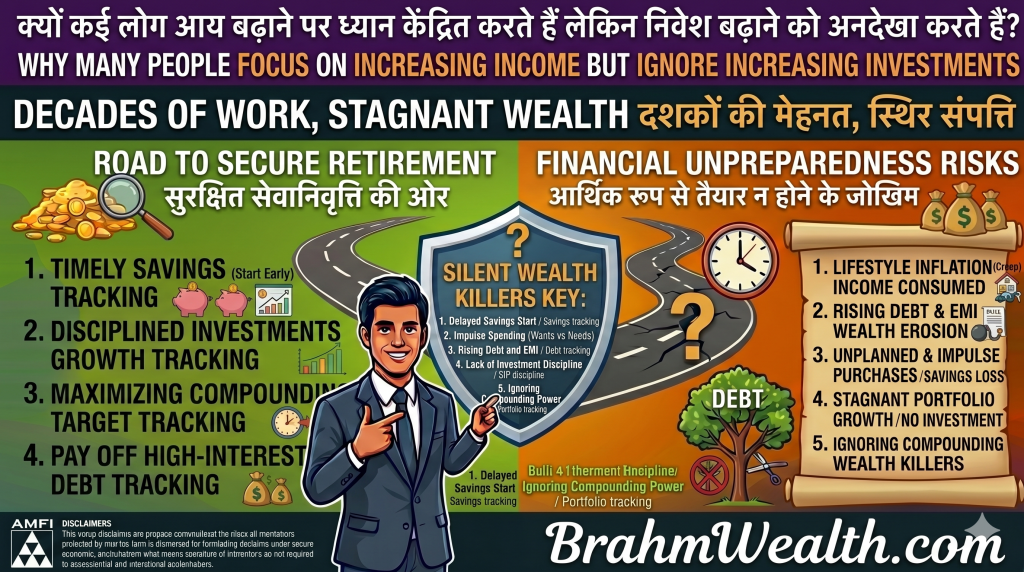
Income Growth Alone May Not Automatically Create Wealth
Narrated by BrahmWealth.com
By Brahm Prakash Rathore — Mutual Fund Distributor ARN359190 | Founder, BrahmWealth
Many people work extremely hard to:
- increase salary,
- grow business income,
- switch jobs,
- or achieve higher professional success.
But despite increasing income:
- investments often remain small,
- wealth creation remains slow,
- and financial stress may still continue.
Why does this happen?
Because:
increasing income and increasing investments are not always the same thing.
This is one of the most important financial awareness lessons in long-term wealth creation.
Why Investment Growth Often Gets Ignored
When income increases:
- lifestyle expectations also rise quickly.
People often upgrade:
- cars,
- gadgets,
- vacations,
- restaurants,
- shopping habits,
- and EMI commitments.
But investments often increase much more slowly.
As a result:
- salary grows,
but: - wealth growth remains limited.
This creates:
lifestyle inflation without asset creation.
Example 1 — Income Growth Without Investment Growth
Let’s compare two individuals.
Person A — Higher Salary, Same Investments
Assumptions
- Income increases from ₹60,000 to ₹1.5 lakh/month over 10 years
- SIP remains only ₹5,000/month
- Lifestyle expenses increase rapidly
Possible Long-Term Result
- weak wealth creation,
- continued financial dependency,
- and limited retirement preparation.
Person B — Income Growth + Investment Growth
Assumptions
- Same salary growth
- SIP starts at ₹5,000/month
- SIP increases gradually every year
- Controlled lifestyle inflation
Approximate Long-Term Outcome
| Details | Amount |
|---|---|
| Approximate Corpus After 25 Years | ₹3–5 crore+ |
This demonstrates:
increasing investments with income growth may potentially create much stronger long-term wealth outcomes.
Why Step-Up SIP Becomes Powerful
One practical investing strategy many long-term investors use is:
Step-Up SIP.
This means:
- SIP amount increases gradually every year,
usually: - after salary increments,
- business growth,
- or income improvement.
Instead of:
- increasing only expenses,
investments also increase systematically.
This may potentially improve:
- long-term compounding,
- retirement preparation,
- and wealth creation significantly.
Example 2 — Normal SIP vs Step-Up SIP
Investor A — Fixed SIP
Assumptions
- SIP = ₹10,000/month
- Investment duration = 25 years
- Expected annual return = 12%
Approximate Outcome
| Details | Amount |
|---|---|
| Approximate Corpus | ₹1.8–2 crore |
Investor B — Step-Up SIP
Assumptions
- Starting SIP = ₹10,000/month
- SIP increases 10% yearly
- Investment duration = 25 years
- Expected annual return = 12%
Approximate Outcome
| Details | Amount |
|---|---|
| Approximate Corpus | ₹5–6 crore+ |
Notice:
- Step-Up investing may potentially create dramatically larger long-term wealth outcomes.
Why Small SIP Increases Create Huge Long-Term Difference
Many people assume:
“Small SIP increases won’t matter much.”
But compounding over decades may potentially create surprisingly large financial differences.
Even:
- ₹1,000–₹2,000 yearly SIP increases
may potentially improve future wealth significantly.
This is why financially aware investors often focus on:
- increasing investments gradually,
not just: - increasing lifestyle expenses.
SIP Future Value Formula
M = P × [((1 + i)^n − 1) / i] × (1 + i)Where:
- M = Future maturity value
- P = Monthly SIP amount
- i = Monthly rate of return
- n = Total number of monthly instalments
This formula helps estimate how regular monthly SIP investments may potentially grow over time through compounding and disciplined long-term investing.
Monthly Rate Formula
i = Annual Return / (12 × 100)Where:
- i = Monthly rate of return
Example:
- Annual return = 12%
- Monthly rate = 1%
Total Number of Months Formula
n = Years × 12Where:
- n = Total number of monthly instalments
Example:
- 25 years = 300 months
Why Many People Never Increase Their Investments
Common reasons include:
- lifestyle inflation,
- lack of financial awareness,
- emotional spending,
- delayed financial planning,
- or belief that “future income will solve everything.”
But long-term wealth creation often depends on:
- disciplined investing behavior,
- increasing investments gradually,
- and allowing compounding enough time to work.
Why Financial Awareness Matters More Today
Modern financial life is becoming increasingly expensive because:
- inflation continues rising,
- retirement periods are longer,
- healthcare costs are increasing,
- and financial responsibility is growing.
This is why:
- investment awareness,
- Step-Up SIP discipline,
- and long-term financial planning
may potentially become extremely important in future wealth creation.
At BrahmWealth.com, the objective is to simplify these financial concepts in practical layman-friendly language for beginners and long-term investors alike.
Important Reality Check
All investment examples in this article are educational illustrations based on assumptions.
Actual returns:
- fluctuate,
- are market-linked,
- and are never guaranteed.
Investors should always evaluate:
- financial goals,
- risk tolerance,
- and investment suitability carefully.
Common Financial Mistakes Many People Make
Many people:
- increase expenses faster than investments,
- delay Step-Up SIP increases,
- focus only on salary growth,
- or underestimate long-term inflation.
Others assume:
small SIP increases won’t matter.
But over decades:
- disciplined investment growth
may potentially create meaningful financial differences.
How Can Someone Increase Investments More Practically?
Simple approaches may include:
- Increasing SIP after salary hikes
- Starting Step-Up SIP gradually
- Controlling unnecessary lifestyle inflation
- Thinking long-term financially
- Prioritizing asset creation alongside income growth
Healthy investing behavior usually improves gradually over time.
Final Thoughts
Increasing income is important.
But:
- increasing investments,
- improving financial discipline,
- and building long-term assets
may potentially become even more important for future financial freedom.
Because:
income may improve present lifestyle —
but disciplined investments may potentially improve long-term financial security.
A Small Positive Note from BrahmWealth
At BrahmWealth.com, our goal is to simplify financial awareness in practical and beginner-friendly language.
If you notice:
- any factual error,
- calculation issue,
- typing mistake,
- or financial concept improvement opportunity in this article,
your feedback is genuinely appreciated.
Learning and improving together may help create a stronger financial awareness ecosystem for everyone.