
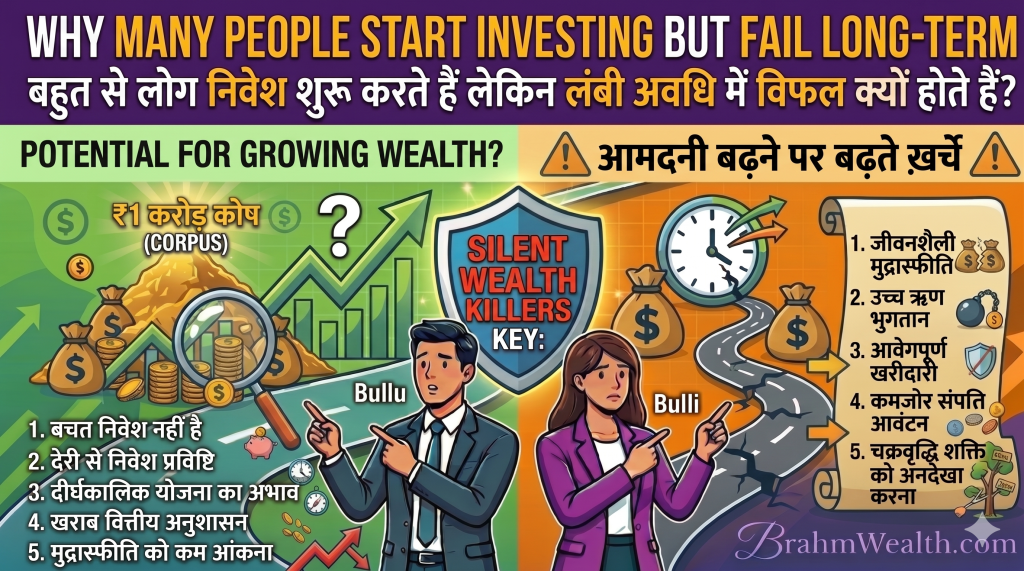
Starting Investments Is Easy — Continuing for Years Is the Real Challenge
Narrated by BrahmWealth.com
By Brahm Prakash Rathore — Mutual Fund Distributor ARN359190 | Founder, BrahmWealth
Many people begin investing with excitement.
Initially:
- motivation feels high,
- financial goals look inspiring,
- and wealth creation sounds exciting.
But after some time:
- market volatility appears,
- returns fluctuate,
- emotions increase,
- and investing discipline often weakens.
As a result:
- many investors stop SIPs,
- withdraw investments early,
- or keep changing strategy repeatedly.
This is one of the biggest reasons why:
many people start investing —
but comparatively fewer people stay invested long enough for compounding to become powerful.
Why Long-Term Investing Feels Difficult Emotionally
Investing is not only financial.
It is also deeply emotional.
During market rises:
- confidence increases,
- excitement grows,
- and investing feels easy.
But during market declines:
- fear increases,
- panic starts,
- and many investors begin doubting long-term investing completely.
This emotional cycle affects:
- beginners,
- salaried investors,
- and sometimes even experienced investors.
Example 1 — Investor Who Stayed vs Investor Who Quit Early
Let’s compare two investors.
Investor A — Stayed Invested
Assumptions
- SIP = ₹10,000/month
- Expected annual return = 12%
- Investment duration = 25 years
- Continued investing during market volatility
Approximate Outcome
| Details | Amount |
|---|---|
| Total Investment | ₹30 lakh |
| Approximate Corpus | ₹1.8–2 crore |
Investor B — Stopped Frequently
Assumptions
- Same SIP amount
- Frequently paused investments during market declines
- Restarted inconsistently
Possible Long-Term Result
- weaker compounding,
- lower accumulated corpus,
- and slower wealth creation.
This demonstrates:
consistency may potentially matter more than trying to invest perfectly.
Why Many Investors Stop SIPs Too Early
Common reasons include:
- fear during market falls,
- unrealistic return expectations,
- comparing portfolios with others,
- social media influence,
- or impatience.
Some people expect:
- quick profits within months.
But healthy long-term wealth creation usually works gradually through:
- discipline,
- patience,
- and time.
Why Compounding Needs Time
Compounding often feels slow initially.
In the beginning:
- portfolio growth may look small,
- progress may feel slow,
- and investors may become impatient.
But over long durations:
- compounding may potentially accelerate significantly.
This is why experienced long-term investors often focus heavily on:
- consistency,
- and staying invested.
Example 2 — The Power of Staying Invested Longer
Assumptions
- SIP = ₹8,000/month
- Expected annual return = 12%
After 10 Years
| Details | Amount |
|---|---|
| Total Investment | ₹9.6 lakh |
| Approximate Corpus | ₹18 lakh |
After 20 Years
| Details | Amount |
|---|---|
| Total Investment | ₹19.2 lakh |
| Approximate Corpus | ₹75–80 lakh |
After 30 Years
| Details | Amount |
|---|---|
| Total Investment | ₹28.8 lakh |
| Approximate Corpus | ₹2.5–3 crore |
Notice:
- later years created significantly stronger growth.
This is how compounding often works:
slow initially, powerful later.
Why Emotional Investing Can Become Dangerous
Many investors:
- react emotionally to headlines,
- panic during temporary declines,
- or stop investing after seeing short-term volatility.
Unfortunately:
- emotional investing often damages long-term wealth creation more than market volatility itself.
This is why financial awareness becomes important.
At BrahmWealth.com, the focus is on helping beginners understand long-term investing behavior in practical layman-friendly language.
Why SIP Investing Helps Many Beginners
SIP investing became popular because:
- investing becomes systematic,
- emotional timing pressure reduces,
- and discipline improves gradually.
SIP investing also helps investors:
- continue investing during both rising and falling markets.
This may potentially improve long-term consistency.
Example 3 — Market Fall vs Disciplined SIP
Imagine:
- market temporarily falls sharply,
- but investor continues ₹5,000 monthly SIP consistently.
During lower market levels:
- more units may potentially get accumulated.
If markets recover later:
- long-term compounding may strengthen further.
This is why many disciplined investors continue SIPs even during uncertainty.
How Compounding Supports Long-Term Wealth Creation
Compounding means:
investment growth may generate additional growth over time.
FV=P×r(1+r)n−1
This is why:
- patience,
- long-term consistency,
- and disciplined SIP investing
may potentially create meaningful future wealth.
Why Investing Is Often More About Behavior Than Intelligence
Many successful long-term investors are not necessarily:
- market experts,
- financial geniuses,
- or full-time traders.
Often, they simply:
- stay disciplined,
- avoid emotional decisions,
- and remain invested longer.
This behavioral advantage may become extremely powerful over decades.
Important Reality Check
All investment examples in this article are educational illustrations based on assumptions.
Actual returns:
- fluctuate,
- are market-linked,
- and are never guaranteed.
Long-term investing always involves:
- uncertainty,
- market volatility,
- and financial risk.
Common Investing Mistakes Many People Make
Many investors:
- stop SIPs emotionally,
- chase quick profits,
- compare returns constantly,
- or invest without long-term planning.
Others assume:
investing success depends only on market timing.
But long-term wealth creation often rewards:
- consistency,
- patience,
- and disciplined behavior.
How Can Someone Improve Long-Term Investing Discipline?
Simple approaches may include:
- Starting with manageable SIP amounts
- Thinking long-term financially
- Avoiding emotional reactions to short-term market moves
- Increasing SIP gradually with income growth
- Reviewing investments periodically instead of daily
Healthy investing discipline usually develops gradually over time.
Final Thoughts
Starting investments is important.
But:
- staying invested,
- remaining disciplined,
- and allowing compounding enough time
may potentially become even more important for long-term wealth creation.
Because:
in investing, patience often becomes one of the biggest financial advantages.