
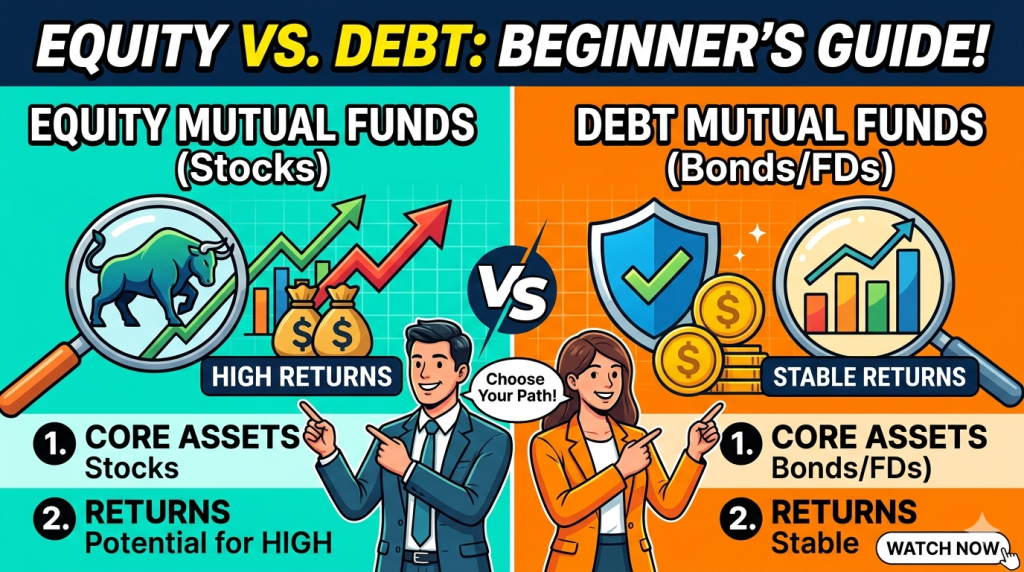
Learn the difference between Equity vs Debt Mutual Funds, their risks, benefits and how beginners can choose investment categories based on financial goals and risk appetite.
Equity vs Debt Mutual Funds: Key Differences Every Beginner Should Know
Understanding different mutual fund categories is an important step for investors beginning their financial journey. Among the most commonly discussed categories are Equity Mutual Funds and Debt Mutual Funds.
Both categories serve different investment objectives and may suit different types of investors depending on financial goals, investment horizon and risk appetite.
Learning the difference between equity and debt mutual funds can help investors make more informed financial decisions and better understand investment diversification.
Table of Contents
What Are Equity Mutual Funds?
Equity Mutual Funds primarily invest in shares and equity-related instruments of companies. These funds are generally associated with long-term wealth creation and market-linked growth opportunities.
The performance of equity mutual funds may be influenced by stock market movements and economic conditions.
Common Features of Equity Mutual Funds
- Market-linked investments
- Higher growth potential
- Suitable for long-term investing
- Higher volatility compared to debt funds
- Professional portfolio management
What Are Debt Mutual Funds?
Debt Mutual Funds primarily invest in fixed-income instruments such as:
- Government securities
- Corporate bonds
- Treasury bills
- Money market instruments
Debt funds are generally considered by investors looking for relatively stable investment options and lower volatility compared to equity-oriented investments.
Common Features of Debt Mutual Funds
- Fixed-income oriented investments
- Lower volatility compared to equity funds
- Suitable for short- to medium-term goals
- Focus on capital preservation and income generation
- Interest rate sensitivity
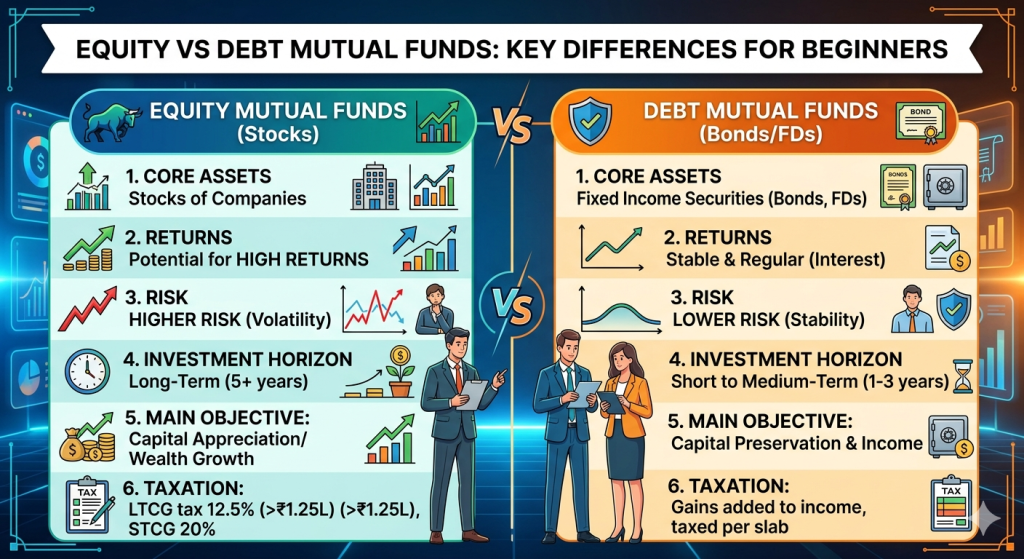
Equity vs Debt Mutual Funds: Key Differences
| Equity Mutual Funds | Debt Mutual Funds |
|---|---|
| Invest mainly in equities | Invest mainly in fixed-income securities |
| Higher market volatility | Relatively lower volatility |
| Long-term wealth creation focus | Stability and income focus |
| Suitable for long-term investors | Suitable for conservative investors |
| Market performance driven | Interest rate and credit driven |
Which Category May Suit Different Investors?
Investment suitability depends on:
- Financial goals
- Investment horizon
- Risk tolerance
- Cash flow requirements
- Market understanding
Some investors may prefer equity-oriented investments for long-term growth, while others may consider debt-oriented investments for stability and lower volatility.
Many investors also use a combination of both categories for diversification and balanced financial planning.
Understanding Investment Risk
All investments carry some level of risk, and market conditions can influence investment performance.
Investors should avoid:
- Emotional investing
- Unrealistic return expectations
- Frequent portfolio changes without planning
Long-term investing generally benefits from disciplined financial planning and informed decision-making.
SIP Investing and Mutual Fund Categories
Many investors use SIP investing to gradually participate in different mutual fund categories according to financial goals and investment strategies.
Understanding SIP investing methods can also help beginners better understand disciplined investing approaches.
Use Financial Planning Tools
Investors often use financial planning calculators to better understand long-term investing and goal planning strategies.
You can also explore our SIP Calculator to estimate potential long-term investment growth through disciplined investing.
Explore Mutual Fund Companies and Investment Resources
You can also visit our Start Investing section to explore educational information about mutual fund companies, investment solutions and guided support through BrahmWealth.
Conclusion
Understanding the difference between equity and debt mutual funds is an important step toward informed financial decision-making. Different investment categories may suit different financial situations, goals and risk profiles.
Investor education, diversification and disciplined investing often play an important role in long-term wealth creation and financial planning.
Need Help Understanding Mutual Fund Categories?
Connect with BrahmWealth for educational guidance and personalized support to better understand mutual fund investing and financial planning concepts.
Talk on WhatsApp
Knowledge Builds Wealth.
Important Disclosure
The information provided in this article is for educational and informational purposes only and should not be construed as investment advice or a recommendation to buy, sell or hold any specific investment product. Mutual fund investments are subject to market risks. Investors should evaluate their financial goals, risk appetite and consult appropriate financial professionals before making investment decisions. Please read all scheme-related documents carefully before investing.